
Church Polity: A Primer
Five common questions answered.

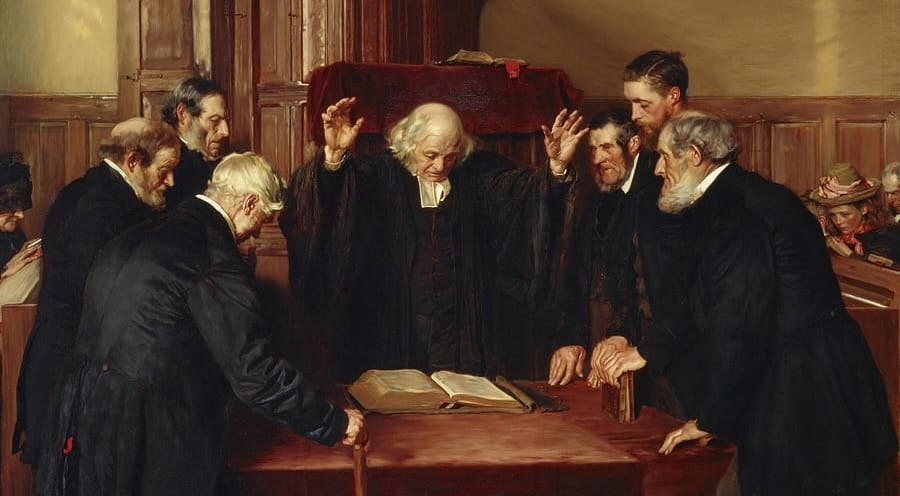
Church polity is an important theological study under ecclesiology that deals with the governance of the church and its various offices. Although it is a vast subject, some introductory matters and basic principles concerning it are presented here in a question-and-answer format. These questions were chosen not only for their foundational nature but also for being those that are commonly put across by people on the matter of church governance.
1. Who are the officers in a church?
The New Testament makes it abundantly clear that the local church has only two officers - Elders and Deacons (1 Tim.3:1-13; Acts 6:1-4; Phil.1:1). Elders are servant-leaders who minister the word (Heb.13:7), rule the church (Heb.13:17), and shepherd God's flock (1 Pet.5:1-4). Deacons are leading-servants that attend to the physical and material needs of God's people (Acts 6:1-4), and also the mercy ministries of the church to her community. In the New Testament, all elders are bishops (or overseers) and all bishops are elders (Acts 20:17,28; Titus 1:5-7). They are not to be separated as two distinct offices. These men [1] are elders by their spiritual maturity, shepherds by their function, and overseers by their office.
2. What is meant by the plurality of elders?
In the New Testament, one observes that every church is to be ruled by a group of elders (Acts.14:23;20:17; Phil 1:1; Titus 1:5; Jas.5:14) and never by one man. This is called the principle of plurality of eldership. This principle, when faithfully obeyed, keeps the church from ever coming under a tyrannical leadership and safeguards it from many pitfalls like personality cult, unaccountable pastors, etc. Plurality of elders enables a church to be led by the Holy Spirit working through all her elders and not merely following the whims of just one man at the top.
3. What is meant by the parity of elders?
In the New Testament, one observes that no elder is given superiority over other elders when it comes to the governance and shepherding of the church. In other words, when it comes to decision-making, no elder has a veto power. Every elder has the same authority and decision-making power as every other elder, as all elders are collectively called to shepherd the flock of God. In Acts, Titus, and 1 Peter, we find all elders are called to be equally committed to the oversight of the church (Acts 20:17,28; Titus 1:5,7; 1 Pet.5:1,2). Unless this principle of parity is affirmed along with the plurality of elders, the principle of plurality is meaningless. For it is possible for churches to merely count the number of their elders and confidently assert their conviction in the plurality of elders and yet, by denying their parity, practically succumb to just one elder having a greater sway in the governance of the church. It usually happens with someone being exalted as the "founding pastor" or the "senior pastor" of a church. Since he was so foundational to the planting of the church, people naturally feel a greater weight for his opinions in church matters. Though such affection and respect are appropriate in some measure, it is unscriptural to grant him a superior power or authority over other elders in the decision-making processes of the church. The New Testament knows no senior or founding pastor as being given a special status in the governance of a church.
It is equally necessary to affirm here that this principle of parity pertains only to the governance of the church and not necessarily to the gifting, visibility and prominence of elders. Not all elders are equally gifted or prominent in the ministry of a church, especially when it comes to the ministry of the word. Paul speaks of certain elders as being more laborious than others in the study and preaching of the word, and hence, such elders deserve a greater honour than other elders (1 Tim.5:17). Historically, some churches have called that elder who takes a greater responsibility for the word ministry, the minister among the elders. It is a better label than to call such an elder the "senior pastor," which clearly gives the wrong message, as if not all elders are equally the shepherds of the church.
4. What should we think about the practice of churches using clerical titles like 'Reverend' or "Pastor" for ministers?
The New Testament does not give much emphasis on the use of clerical titles while addressing ministers (2 Pet.3:15). It, in fact, condemns the use of all religious titles by leaders of God's people as a means to exalt themselves above the people (Matt.23:7-12). Titles found in the New Testament, like "minister" (1 Tim.4:6), "elder" (1 Tim.5:19), "pastor" (Eph.4:11), "bishop/overseer" (1 Tim.3:1), etc., are all clearly ministerial or functional.
Now, here it is to be pointed out that the common argument made by many Bible-believing Christians against the title "Reverend" is a flawed one. People typically just take a verse from the KJV, Psalm 111:9 and assert that this title is exclusively reserved for God. Thus, they charge those ministers using the title, Reverend, as trying to steal God's glory by taking His title. Now, this argument is flawed because the root Hebrew word used by the Holy Spirit in this verse is used by the same Spirit of God in other parts of the Bible to denote not only God, but also men and things. According to the New International Dictionary of Old Testament Theology and Exegesis (NIDOTTE), the root word יָרֵא (yare'), which means "(q) fear, be afraid; (ni) be feared, reverenced, held in honour, worship" with its verbal form appearing "some 333 times" in the Old Testament, "80 percent of the passages, the object of fear is God" but the remaining ones are used in connection with men and things (NIDOTTE 2.527ff). For example, see verses like Leviticus 19:3, which speaks of honouring one's parents; Leviticus 19:30, which speaks of reverencing the sanctuary; Joshua 4:14, where Moses and Joshua are said to be leaders honoured by the Israelites; and in 1 Kings 3:28, Solomon is respected by all Israel for the wisdom of God in him. Many such examples could be cited from the Old Testament, but suffice to say, these few verses clearly prove that this root word in Hebrew is not some sacred title reserved only for God. Also, the same verse in Psalm 111 attributes 'holy' to the name of God as it does 'reverend'. No one, therefore, contends that holy should be used exclusively of God alone. Clearly, the Bible itself uses the word 'holy' in connection with both sanctified men (Ps.34:9) and sacred places (Ex.29:31). Thus, all Psalm 111:9 is saying is that the Name of God is to be hallowed and honoured by the people of God. It is not teaching us any exclusive title reserved for God alone. Thus, though the desire to honour God alone and avoid clerical titles is a worthy one, to use this verse to justify it is not based on sound exegesis.
Historically, some churches, especially Protestant ones, employed this title 'reverend' not with the intention to elevate any man but to show honour that is due for the office occupied by the man. In the same manner as we call a judge by the honorific "Hon'ble", "Reverend" was an honorific for the minister. Honouring an elder is biblically sanctioned (1 Thess.5:12-13), and if some use the title 'reverend' in the sense of an honorific, it is not a sin. However, the overall thrust of the New Testament is to avoid all religious titles, and hence it's best advised to avoid all of them.
5. How should the church be governed according to the New Testament?
A survey of the New Testament would make us summarise the following five foundational truths concerning the governance of the church:
- Lord Jesus Christ alone is the head of the church (Eph.1:22; 4:15; 5:23). No ecclesiastical or political authority is the head of the church. Hence, it is the will of Christ as revealed in the Scriptures that ought to be the standard by which all things must be done in the church.
- Lord Jesus Christ alone calls and gifts men to be office-bearers in the church (Eph.4:11, Acts.13:2), who are identified and nominated by each congregation (Acts.6:3-6; 1 Tim.3:1-15), but also examined and confirmed by a council of elders (1 Tim.4:14; Acts 6:6; 13:3; 14:23).
- According to the revealed will of Lord Jesus Christ, all elders are bishops, and all bishops are elders, with parity (Acts 20:17,28; Titus 1:5-7).
- Lord Jesus Christ commands each congregation to be ruled by a plurality of elders who are assisted in their ministry by deacons (Acts 14:23; 6:1-6; Phil 1:1).
- Lord Jesus Christ has prescribed that in the case of disputed matters, be it doctrine or discipline, a congregation has the right to appeal to a wider council of elders in a region (Acts 15:2) and send her representative messengers (Acts 15:3a) to such general assemblies for corporate resolution (Acts 15:4,22,23,25,28). The decision made by such wider governing bodies is authoritative over all local congregations in communion with each other (Acts 15:30; 16:1,4,5). [2]
When we compare this inspired ecclesiology with the practices of various Christian churches, we find the following:
- Both Roman Catholics (by their exaltation of the Pope as the vicar of Christ) and Anglicans (by their exaltation of the King as the supreme governor, and the Archbishop of Canterbury as the spiritual head of the church) fail at point 1 itself.
- All episcopal churches (Anglicans, Lutherans, Methodists, Orthodox) fail at point 3 by their unbiblical interpretation and exaltation of the office of bishops.
- Independent, non-denominational, and congregational churches (Baptists[3], Pentecostals, Charismatics) generally fail to follow points 2 and 5 by letting a man enter ministry without an official examination by a council of elders and also by not manifesting a formal and corporate unity, especially in resolving difficult matters through wider councils of elders in a region.
Only in the Presbyterian model of church governance (found in confessional Reformed churches and in some hybrid form in Pentecostal denominations like Assemblies of God), do we find all of these 5 points of New Testament polity being put into practice.
The New Testament unanimously testifies that the office of the elder is reserved only for men. ↩︎
Some have objected to the application of Acts 15 as instructive for the church today due to the presence of apostles in this assembly. It is to be noted that in this general assembly, although apostles were present, they brought none of their supernatural gifts or inspiration to settle the issue. They reasoned like all others by considering Scripture and the ways of the Lord. There was no authoritative "Thus saith the Lord" from any apostle to settle the issue. Had it been so, Paul himself could have settled it by his revelatory gifts in the church at Antioch itself. There would not have been a Jerusalem assembly then. Rather, here in this assembly, we have apostles acting like fellow elders (as Peter calls himself in 1 Pet.5:1), reasoning and deciding on the basis of God's word alone. ↩︎
All Baptists, except Reformed Baptists. Confessional Reformed Baptists do follow points 2 and 5 with slight modification. According to the 1689 confession of faith used by Reformed Baptists, ministerial candidates are nominated by the church and set apart by the laying on of hands by the elders of that same local church (1689 ch. 26.9). In other words, ordination is done by the session of the local church and not by a regional presbytery. Also, according to the 1689 confession, communing churches in a region are encouraged to assemble together for resolving difficulties and disputes; however, they deny such assemblies and their decisions as having any authority over participating churches (1689 ch. 26.15). ↩︎